Mathematics Study Guide for the HiSET Test
Page 7
Graphic Representation
We mentioned earlier that we can solve a system of equations by graphing. We can solve almost any equation by graphing. Graphing gives us a visual picture of the mathematical problem we are solving. When solving a system, the graph shows the intersection point of the two equations, which is the solution to the system as shown below.
Example:
Solve the following system of equations by graphing the system.
\[\begin{array}{r}x - y &=& - 4\\3x + 2y &=& - 2\end{array}\]Answer: \(( - 2,2)\)
Explanation:
The graph below shows that the solution (the point of intersection) is \(( - 2,2).\)

Equations
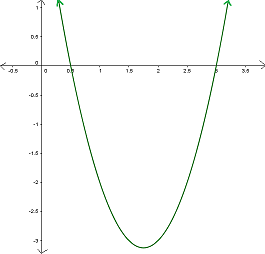
If we use graphing to solve a quadratic equation, the solution(s), if they exist, to the equation are the \(x\)-intercepts.
Example:
Solve \(2{x^2} - 7x + 4 = 0\) using graphing.
Answer: \(x = \frac{1}{2},\;3\)
Explanation:
The graph below shows that the \(x\)-intercepts are \(\left( {\frac{1}{2},0} \right)\;{\rm{and}}\;(3,0),\) so the solutions to the equation are \(x = \frac{1}{2},\;3.\)
Inequalities
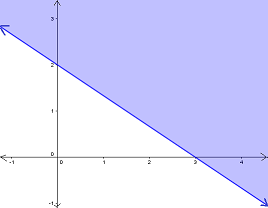
When we graph an inequality, the solution is shown with shading. If we solve with \(y\) on the left side and the inequality symbol is \(\ge,\) the shading is above a solid line, indicating that the solution includes the line. If the inequality symbol is \(\le,\) the shading is below a solid line. If the inequality symbol is \(\gt\), the shading is above a dotted line, indicating that the solution does not include the line. If the inequality symbol is \(\lt\), the shading is below a dotted line.
Example:
Graph the solution set for the inequality: \(3x + 2y \ge 6\)
Answer:
Functions
A mathematical relation is a function if it has the properties of a function. A function is a correspondence between two sets, the domain, which is the input of the relation, and the range, which is the output of the relation. The relation is a function if each member of the domain has exactly one member of the range. An example of a function is:
\[g:\;x \to 3x - 2.\]This means that when given a value of the input \(x,\) that value is tripled and then reduced by \(2.\)
Function Notation
Functions are often defined simply by giving an equation for \(f(x),\) the notation for the function, and specifying the domain. This notation is used when defining a function. However, any letter can be used to designate the function, such as \(g(x),\;h(x),\;{\rm{or}}\;k(x),\) just to name a few. An example of showing function notation is: \(f(x) = {x^2} - x + 19\) This function squares the input, then reduces that value by the input and adds \(19.\)
A common task is to evaluate a function for a specific input value.
Example:
Evaluate \(g(x) = 3{x^2} + 4x - 7\) for \(x=5.\)
Answer: \(57\)
Explanation:
If \(x=4,\) substitute \(4\) for \(x\) in the function.
\[\begin{array}{l}g(x) &=& 3{\left( 4 \right)^2} + 4\left( 4 \right) - 7\\ &=& 3(16) + 16 - 7\\ &=& 48 + 16 - 7\\ &=& 57\end{array}\]Domain and Range
The domain of a function is the set of input values for the function. The range is the output of a function, which is the result of the function acting on the domain value. Domain values may have restrictions. First, any value that would make the function undefined, cannot be in the domain. This includes values that would make a denominator of a rational function equal zero, or values that would make a square root, or other even-index radical contain a negative number.
Example 1:
State the domain of \(f(x) = \frac{{3x - 5}}{{(x - 2)(x + 7)}}\)
Answer: All real numbers except \(2\) and \(-7\)
Explanation:
Based on the denominator of the function, \(2\) and \(-7\) cause the denominator to equal to zero, thus making the function undefined. Therefore, these two numbers cannot be included in the domain.
Example 2:
State the domain of \(g(x) = 5\sqrt {9 - {x^2}}\)
Answer: \(- 3 \le x \le 3\)
Explanation: \(g(x) = 5\sqrt {9 - {x^2}}\) The expression \(9 - {x^2}\) must be greater than or equal to zero.
\[\begin{array}{*{20}{c}}{9 - {x^2} \ge 0}\\{ - {x^2} \ge - 9}\\{{x^2} \le 9}\\{ - 3 \le x \le 3}\\\end{array}\]Quantity Relationships
A sequence is a quantitative relationship between a term number and a term value. A sequence can be defined as a function whose domain consists of consecutive positive integers called term numbers. Each corresponding value is called a term of the sequence. A sequence is finite if it has a limited number of terms and infinite if it does not. Every sequence has two different rules. The recursive rule uses the previous term to determine the following term. The explicit rule uses the term number to determine the value of any term.
Arithmetic Sequences
An arithmetic sequence has a common difference, which means the difference between any consecutive two terms is constant, and can be either positive or negative.
The general recursive rule for an arithmetic sequence is \({a_n} = {a_{n - 1}} + d\) where \(a_n\) is the value of the \(nth\) term, \(d\) is the common difference, and \(a_{n-1}\) is the value of the \((n-1)th\) term. If we want to use the recursive formula to find any term, we must know the value of the preceding term value.
Example:
Suppose the \(7th\) term of an arithmetic sequence is \(45\) and the common difference is \(9.\) What is the \(8th\) term?
Answer: \(54\)
Explanation:
The recursive formula for the sequence is \({a_n} = {a_{n - 1}} + 9\) where, in this example, \(n-1\) is \(7\) and \(n\) is \(8.\) Using the recursive formula, we have:
\[{a_8} = {a_7} + 9;\;{a_8} = 45 + 9 = 54.\]The general explicit formula for an arithmetic sequence is \({a_n} = {a_1} + d(n - 1)\) where \(a_n\) is the value of the \(nth\) term, \(d\) is the common difference, and \(n\) is the term number. When using the explicit formula, we must know the value of the first term.
Example:
Suppose the first term of an arithmetic sequence is \(13\) and the common difference is \(3,\) what is the \(75th\) term?
Answer: \(235\)
Explanation:
The explicit formula for the sequence is \({a_n} = 13 + 3(n - 1)\) where, in this example, \(n\) is \(75.\) Using the explicit formula, we have:
\[{a_{75}} = 13 + 3(75 - 1) = 13 + 3 \cdot 74 = 13 + 222 = 235\]Geometric Sequences
A geometric sequence has a common ratio, which means the quotient between any consecutive two terms is constant, and can be either positive or negative.
The general recursive rule for a geometric sequence is \({a_n} = {a_{n - 1}} \cdot r\) where \(a_n\) is the value of the \(nth\) term, \(r\) is the common ratio, and \(a_{n-1}\) is the value of the \((n-1)th\) term. If we want to use the recursive formula to find any term, we must know the value of the preceding term value.
Example:
Suppose the \(9th\) term of a geometric sequence is \(13\) and the common ratio is \(4.\) What is the \(10th\) term?
Answer: \(52\)
Explanation:
The recursive formula for the sequence is \({a_n} = {a_{n - 1}} \cdot 4\) where, in this example, \(n-1\) is \(9\) and \(n\) is \(10.\) Using \({a_n} = {a_1} + d(n - 1)\), the recursive formula, we have:
\[{a_{10}} = {a_9} \cdot 4;\;{a_{10}} = 13 \cdot 4 = 52.\]The general explicit formula for a geometric sequence is \({a_n} = {a_1} \cdot {r^{n - 1}}\) where \(a_n\) is the value of the \(nth\) term, \(r\) is the common ratio, and \(n\) is the term number. When using the explicit formula, we must know the value of the first term.
Example:
Suppose the first term of a geometric sequence is \(7\) and the common ratio is \(3,\) what is the \(6th\) term?
Answer: \(1701\)
Explanation:
The explicit formula for the sequence is \({a_n} = 7 \cdot {3^{6 - 1}}\) where, in this example, \(n\) is \(6.\) Using the explicit formula, we have:
\[{a_6} = 7 \cdot {3^{6 - 1}} = 7 \cdot {3^5} = 7 \cdot 243 = 1701.\]Key Features
When we look at graphs, we can understand them better when we identify their key features. The typical key features of a graph are the intercepts. The \(y\)-intercept is the \(y\)-value at which the graph crosses the \(y\)-axis. The \(x\)-intercept is the \(x\)-value at which the graph crosses the \(x\)-axis. If the graph displays a linear function, then another key feature is the slope of the line in the graph. Slope is commonly referred to as rise over run. If the line slopes downward from left to right, the slope is negative. If the line slopes upward from left to right, the slope is positive.
If the graph contains a curve, we have additional key features. Graphs of curves have maximum values and minimum values, which are considered key features of the graphs. These graphs can have more than one maximum value and more than one minimum value. Lastly, a curve has turning points, where the graph changes direction, even slightly. If we count the number of turning points on the graph we can identify the degree of the function represented by the curve by subtracting one from the number of turning points.
When we see a table of values rather than a graph, the values in the table show the same key features as the graph. If the table contains a \(0\) for \(x,\) we can find the \(y\)-intercept. Similarly, if the table contains a \(0\) for \(y\), we can find the \(x\)-intercepts. Likewise, if the \(y\)-values in the table are increasing or decreasing as the values of \(x\) increase, we can identify the sign and value of the slope.
Working With Functions
A function gives a relationship between an input variable, called the independent variable and the output variable called the dependent variable. The variable \(x\) is always the independent variable and the variable \(y\) is always the dependent variable, called such because the value of \(y\) depends on the value of \(x.\) We can write a function if we know what the function does to the input variable.
For example, suppose a function’s definition multiplies the input variable by five and then adds three. Using this information, we can write the function as: \(f(x) = 3x + 5\). Another function’s definition shows that the function squares the input variable, adds three times the square root of the input variable and then subtracts five. We can write the function as: \(h(x) = {x^2} + 3\sqrt x - 5\).
Evaluating Functions
We mentioned earlier, we can evaluate a function for a specific input from the domain set when we know the function definition.
Example 1:
Evaluate \(h(x) = \frac{1}{{x - 2}} + \frac{4}{{{x^2} - 4}}\) for \(x=3.\)
Answer: \(1.8\) or \(\frac{9}{5}\)
Explanation:
Substitute \(3\) into the function for each \(x.\) Calculate the resulting value, as shown below.
\[h(3) = \frac{1}{{3 - 2}} + \frac{4}{{{3^2} - 4}} = 1 + \frac{4}{5} = \frac{9}{5}\]Example 2:
Evaluate \(g(x) = 5x^3-9x^2+12x-6\) for \(x=2.\)
Answer: \(22\)
Explanation:
Substitute \(2\) into the function for each \(x.\) Calculate the resulting value, as shown below.
\[\begin{array}{l}g(2) &=& 5{\left( 2 \right)^3} - 9{\left( 2 \right)^2} + 12\left( 2 \right) - 6\\ &=& 40 - 36 + 24 - 6\\ &=& 22\end{array}\]Solving Function Equations
When solving function equations, suppose we want the output value for a certain input value. We substitute the given input value for the input variable, usually \(x\), and perform the algebraic operations to find the value of the function expression. This results in the output value.
Suppose we want the input value for a certain output value. We substitute the given output value for the output variable, usually \(y\), making the function expression equal to that number, and perform the algebraic operations to find the input value of the function expression. This results in the input value.
Example:
Given the function \(g(x) = 3{x^2} - 5x + 4,\) what positive \(x\)-value results in \(y=6?\)
Answer: \(2\)
Explanation:
Set \(g(x)\) equal to \(6.\) Then solve for \(x.\) Because the function is a quadratic function, we set the quadratic expression equal to zero and solve for \(x\) using factoring.
\[\begin{array}{l}g(x) &=& 3{x^2} - 5x + 4\\6 &=& 3{x^2} - 5x + 4\\0 &=& 3{x^2} - 5x - 2\\0 &=& (3x + 1)(x - 2)\\x &=& - \frac{1}{3},2\end{array}\]Since the example asks for the positive \(x\)-value, we select \(2.\)
Rate of Change
Rate of change is another name for slope. Slope is commonly known as rise over run or the change of \(x\) over the change of \(y.\)
The formula for calculating the slope between points \(\left( {{x_1},{y_1}} \right)\;{\rm{and}}\;\left( {{x_2},{y_2}} \right)\) is \(\frac{{{y_2} - {y_1}}}{{{x_2} - {x_1}}}.\)
Example 1:
Find the slope of the line that connects \(\left( {3,2} \right)\;{\rm{and}}\;\left( {7,10} \right).\)
Answer: \(2\)
Explanation:
Substitute the values into the slope formula.
\[\frac{{{y_2} - {y_1}}}{{{x_2} - {x_1}}};\;\left( {3,2} \right)\;{\rm{and}}\;\left( {7,10} \right);\;\frac{{10 - 2}}{{7 - 3}} = \frac{8}{4} = 2\]Example 2:
Find the slope of the line that connects \(\left( {2,-3} \right)\;{\rm{and}}\;\left( {-6,7} \right).\)
Answer: \(- \frac{5}{4}\)
Explanation:
Substitute the values into the slope formula.
\[\frac{{{y_2} - {y_1}}}{{{x_2} - {x_1}}};\;\left( {2, - 3} \right)\;{\rm{and}}\;\left( { - 6,7} \right);\;\frac{{7 - ( - 3)}}{{ - 6 - 2}} = \frac{{10}}{{ - 8}} = - \frac{5}{4}\]Mathematics Processes
As you complete the test questions, your ability to understand and use mathematical processes will come into play. These are the particular skills that will be tested, so be sure to choose math practice that requires you to do all of them.
Concepts and Procedures
Order of operations is an extremely important concept.
Remember to follow the order of operations (PEMDAS):
Do everything in parentheses (P), left to right.
Evaluate any exponents (E), left to right.
Do all multiplication and division MD), in order, left to right.
Then do all addition and subtraction (AS), in order, from left to right.
A good way to remember this order is: Please Excuse My Dear Aunt Sally
Use this order of operations for virtually everything; solving equations, evaluating functions, finding area and volume, just to name a few.
Choosing the Appropriate Procedure
Use good strategies when solving problems. Expect the test to contain word problems. If you encounter a word problem, read and re-read the problem so you understand it entirely. Know what information the problem gives you and what the problem asks you to find. If you can, model the problem with a diagram. Then, select a variable and write an equation or model. Solve the equation using the correct order of operations. Once you have an answer, check to see if it makes sense and answers the question. Use the correct units in your final answer.
Examples and Counterexamples
If you are proving an if-then statement, you can interchange the if part and the then part. This gives you the converse of the original statement. The original if-then statement might be true, but realize that the converse might not be true. Bear in mind that you can test the original statement many times, showing the statement is true, but as soon as you find an example that makes the statement false, you have found a counterexample. In algebra, a counterexample is a single numerical example that makes a statement false.
Analysis and Interpretation
Analysis and interpretation is the process by which sense and meaning are made of the data gathered in qualitative research. It is with this process by which the additional knowledge is applied to problems. This data often takes the form of records of group discussions and interviews but is not limited to these processes. When we solve a mathematical problem, we need to make sure we analyze the results and correctly interpret them in the context that the problem is given.
Inferences and Predictions
We can use data sets to create prediction functions, commonly known as lines of best fit. Use the function of the line of best fit to identify good estimated values for places within the data set using interpolation, and to estimate values for places outside the data set using extrapolation.
Source Variety
Remember what we previously said, that we can use as many examples as we want, but still not prove a hypothesis. To increase the confidence in the results of our tests or examples, we need to use as large a variety of input values as possible to further prove the hypothesis. We cannot rely on whole numbers. For example, we should also consider fractions, decimals, and irrational numbers. If we are looking for a maximum or minimum value of a function, for example, we should not input arbitrary values from the domain and be satisfied with the lowest output. We should graph the function and identify the maximum or minimum value from the graph.
Synthesis and Problem-Solving
Creativity is an open-minded ability to look at things from multiple angles, and solve problems through the use of wide experience, hard work, imagination, intuition, perseverance and, at times, a dose of good luck. Creativity is very important in critical thinking. Creative thinking goes way beyond learning, understanding, and analysis of material. It requires that you step outside the box of what others have said and construct your own solution to a problem.
Problem-solving is very important in mathematics. A primary goal of mathematics teaching and learning is to develop the ability to solve a wide variety of complex mathematics problems. To most mathematically literate people, mathematics is synonymous with solving problems—doing word problems, creating patterns, interpreting figures, developing geometric constructions, proving theorems, etc. Your goal should be to become mathematically literate, which gives you a greater ability to solve problems, both on the job and in your personal life.
Reasoning Quantitatively
The definition of quantitative reasoning is the application of basic mathematics skills, such as algebra, to the analysis and interpretation of real-world quantitative information. This reasoning helps us put the mathematics of a problem in the context of number properties to draw conclusions that are relevant to us in our daily lives. This means that when you encounter a problem, approach it numerically if possible, which allows you to create a model and find a solution.
Evaluating Solutions
There are various ways of evaluating the possible solutions to a problem. The evaluation process is divided into six steps. First, we define the ideal solution. Next, we eliminate impossible solutions, such as those which do not satisfy constraints given in the problem. Third, we evaluate the remaining solutions against the required results we are looking for. Next, we assess the risks associated with what we think is the best solution, and finally, make a decision. Algebra allows us to do this process through the use of domain and range, calculating a solution, and checking the answer for reasonableness.
All Study Guides for the HiSET Test are now available as downloadable PDFs