What’s on the ParaPathways Test?
Paraprofessionals are some of the busiest people in any school. They work one-on-one with students who need extra help, lead small reading groups, support students with disabilities, and keep classrooms running smoothly. If you want to join them, there’s a good chance you’ll need to pass a test first.
For years, that test was the ParaPro Assessment. Now there’s a new one: ParaPathways. So, what is the ParaPathways test, who needs to take it, and how is it different from the test it replaces? Read on for everything you need to know before you register.
What Is the ParaPathways Test?
ParaPathways is a computer-based exam from the Educational Testing Service (ETS) that measures the basic skills a paraprofessional needs to support students in a classroom. ETS introduced it in September 2025 as the successor to the ParaPro Assessment.
The test checks two things:
- Your own skills in reading, writing, and math
- Your ability to apply those skills to help students in real classroom situations
About two-thirds of the questions in each section focus on basic skills and knowledge. The other third ask you to use that knowledge in a classroom context, such as choosing the best way to help a student who is stuck on a word or a math problem.
The full test is code 5757. It is made up of two separately timed subtests:
- Reading and Writing (5758)
- Mathematics (5759)
Who Needs to Take ParaPathways?
Federal law sets minimum qualifications for paraprofessionals who provide instructional support in Title I programs. These paras must have a high school diploma or its equivalent, plus one of the following:
- two years of study at a college or university
- an associate degree or higher
- a passing score on a formal state or local academic assessment that shows they can help teach reading, writing, and math
ParaPathways is one of the assessments states and school districts use to meet that third requirement. Many districts apply the same standard to all paraprofessionals, not just those in Title I programs. If you don’t have two years of college or an associate degree, passing ParaPathways may be your path into the job.
Requirements vary, so check your state’s requirements on the ETS website or ask your school district which test it accepts and what score you need.
ParaPathways vs. ParaPro: What’s the Difference?
ParaPathways builds on the ParaPro Assessment, so if you’ve studied for ParaPro, much of the content will look familiar. ETS is still offering ParaPro during the transition, and each state or district decides which test it accepts. Some states now accept only ParaPathways, others still accept only ParaPro, and some accept either one. Arkansas and Maryland, for example, accept ParaPro scores through August 31, 2027.
Here are the biggest differences:
-
Two separate subtests. ParaPro was a single test. ParaPathways splits into a Reading and Writing subtest and a Math subtest, and you can retake just the one you need.
-
A new scoring scale. ParaPathways scores range from 310 to 350, so ParaPro scores (such as 457 or 460) don’t translate directly.
-
Updated reading content. ETS says the reading and writing content is grounded in the science of reading, with less emphasis on older strategies like skimming.
-
More focus on real-world skills. Math questions emphasize practical problem-solving with numbers, measurement, geometry, and data. Writing questions include credible sources and responsible use of technology.
What’s on the ParaPathways Test?

Reading and Writing (5758)
You’ll have 85 minutes to answer about 51 questions.
-
Reading (about 30 questions, 60%) covers phonemic awareness, phonics, word analysis, vocabulary, fluency, comprehension, and the use of evidence from a text. You may also see questions about reading charts, graphs, and other visuals.
-
Writing (about 21 questions, 40%) covers grammar, usage, punctuation, the writing process, types of writing, using credible sources, and using technology responsibly to support writing.
Mathematics (5759)
You’ll have 60 minutes to answer about 36 questions.
-
Numbers and Operations (about 18 questions, 50%) covers place value, fractions, decimals, percentages, and basic computation.
-
Geometry, Measurement, and Data Analysis (about 18 questions, 50%) covers shapes, units of measurement, and reading and interpreting data in tables and graphs.
An on-screen four-function calculator is provided for the math subtest.
How Is the Test Given?
ParaPathways is taken on a computer, either at a test center or at home with a live online proctor. Test centers include community testing sites, participating school districts, and regional education offices.
Most questions are multiple-choice, but you may also see:
-
questions with more than one correct answer
-
questions where you type a number into a box
-
questions where you click on part of a graphic or a sentence in a passage
-
drag-and-drop and drop-down menu questions
Each subtest also includes a few unscored questions that ETS is trying out for future tests. You won’t know which ones they are, so give every question your best effort. There is no penalty for guessing, so never leave a question blank.
How Much Does ParaPathways Cost?
According to the ETS 2026–27 information bulletin, fees depend on where you test:
| Test | At a Test Center | At Home |
|---|---|---|
| Full test (5757) | $59 | $75 |
| Reading and Writing only (5758) | $29.50 | $37.50 |
| Mathematics only (5759) | $29.50 | $37.50 |
Some test centers charge an additional proctoring fee, so ask when you schedule.
How Is ParaPathways Scored?
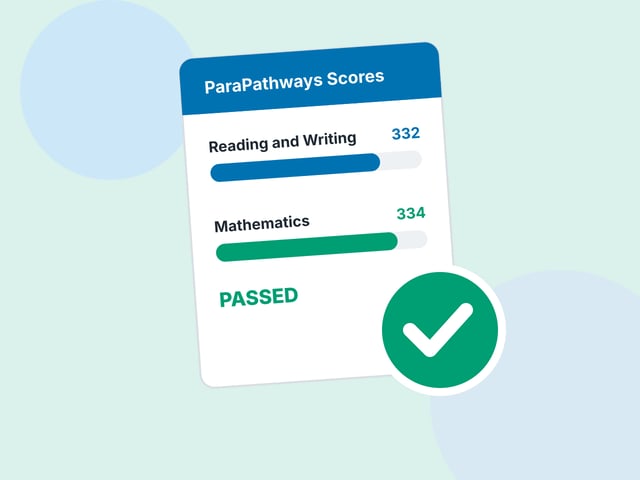
Each subtest is scored separately on a scale of 310 to 350. You must reach your state’s passing score on both subtests. The most common passing scores are 332 for Reading and Writing and 334 for Mathematics, but some states set them lower.
If you pass one subtest but not the other, you only need to retake the one you missed. For a full breakdown of passing scores by state, see our article What Is a Passing Score on ParaPathways?
How to Prepare for ParaPathways
The skills on ParaPathways aren’t advanced, but many test takers haven’t practiced them in years. A few weeks of focused review can make a big difference.
ParaPathways Study Guides
Our ParaPathways study guides walk you through every topic on the test, from phonics and fluency to fractions and data. Start with the areas you feel least confident about.
ParaPathways Flashcards
Flashcards are perfect for quick review on a lunch break or between classes. Use them to lock in vocabulary, grammar rules, and math formulas.
ParaPathways Practice Tests
Our ParaPathways practice questions show you exactly what to expect and help you build the pacing you’ll need on test day. Time yourself to make sure you can finish each subtest comfortably.
Your Path to the Classroom Starts Here
Paraprofessionals make a real difference in students’ lives, and ParaPathways is your chance to show you’re ready for the role. Find out what your state requires, set aside some study time, and use our free resources to walk into the test with confidence.