What Is a Passing Score on ParaPathways?
You’ve studied, you’ve practiced, and your test date is on the calendar. Now one question is probably on your mind: what score do you actually need to pass ParaPathways?
The answer depends on where you plan to work. ParaPathways doesn’t have one national passing score. Instead, each state (and sometimes each school district) sets its own. Here’s how ParaPathways scoring works, what the most common passing scores are, and what to do if you don’t pass on your first try.
How Is ParaPathways Scored?
ParaPathways has two subtests, and each one is scored separately:
-
Reading and Writing (5758)
-
Mathematics (5759)
Each subtest is reported on a scale of 310 to 350. Your scaled score is based on the number of questions you answer correctly (your raw score), which ETS converts to the 310–350 scale. The conversion accounts for small differences in difficulty between versions of the test, so a 332 means the same thing no matter which version you take.
A few other things to know:
-
There is no penalty for wrong answers. Your score only counts correct answers, so always choose an answer, even if you have to guess.
-
Some questions don’t count. Each subtest includes a few unscored questions that ETS is trying out for future tests. You won’t know which ones they are.
-
You must pass both subtests. A high score on one subtest can’t make up for a low score on the other.
What Is a Passing Score on ParaPathways?

Most states that use ParaPathways require:
-
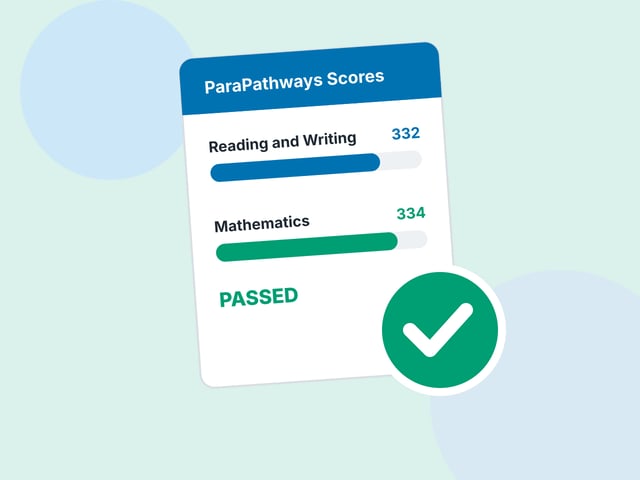
332 on Reading and Writing
-
334 on Mathematics
These match the passing scores recommended in state standard-setting studies, such as Utah’s. A few states have set lower passing scores, from 322 to 329 for Reading and Writing and 325 to 332 for Math.
ParaPathways Passing Scores by State
The table below lists the states and agencies that accept ParaPathways, along with their required scores, according to the ETS state requirements page as of November 2026. Requirements can change, so always confirm with ETS or your state department of education before you test.
| State or Agency | Reading and Writing (5758) | Mathematics (5759) |
|---|---|---|
| Arkansas | 322 | 325 |
| Connecticut | 332 | 334 |
| Delaware | 332 | 334 |
| District of Columbia | 332 | 334 |
| Florida: Hernando County School District | 332 | 334 |
| Hawaii | 332 | 334 |
| Idaho | 332 | 334 |
| Indiana | 332 | 334 |
| Louisiana | 332 | 334 |
| Maryland | 332 | 334 |
| Minnesota | 332 | 332 |
| Missouri | 322 | 325 |
| Nevada | 329 | 334 |
| New Mexico | 332 | 334 |
| North Dakota | 332 | 334 |
| Oklahoma | 332 | 334 |
| Rhode Island | 332 | 334 |
| South Carolina | 332 | 334 |
| South Dakota | 329 | 334 |
| Tennessee | 332 | 334 |
| Utah | 332 | 334 |
| Vermont | 332 | 334 |
| Virginia | 332 | 334 |
| Washington | 324 | 325 |
| West Virginia | 332 | 334 |
| Wisconsin | 332 | 334 |
| Wyoming | 332 | 334 |
Don’t see your state? Many states and districts still accept the ParaPro Assessment during the transition to ParaPathways, and some set their own requirements. Check with the school district where you want to work.
How Many Questions Do You Need to Get Right?
ETS doesn’t publish a fixed number of correct answers needed to pass, because the conversion from raw score to scaled score can vary slightly from one version of the test to another. However, standard-setting reports give a good estimate.
In one state’s standard-setting report, the recommended passing scores worked out to about:
-
28 out of 45 scored questions on Reading and Writing (about 62%) for a score of 332
-
20 out of 30 scored questions on Mathematics (about 67%) for a score of 334
In other words, you don’t need a perfect score. If you can consistently answer about two-thirds of the questions correctly on practice tests, you’re likely in good shape for the most common passing scores. Aim a little higher to give yourself a cushion.
When Will You Get Your Scores?
You’ll see your unofficial scores on the screen as soon as you finish the test. If you test at a test center, you can print them; if you test at home, you can view them but not print them.
Official scores are sent electronically about one week after your test date. They go to the score recipient you choose when you register, such as your state or school district.
What If You Don’t Pass?
Not passing on the first try is more common than you might think, and the good news is that ParaPathways makes it easy to try again.
-
Retake only the subtest you need. If you passed Math but not Reading and Writing, you only have to retake Reading and Writing.
-
Retake right away once. You can retake the test once as soon as you’d like.
-
Wait 21 days after that. After your second attempt, you must wait 21 days before testing again. The 21-day wait applies after every two attempts.
Think about which topics gave you the most trouble, and focus your study time there before your next attempt.
Can You Still Use a ParaPro Score?
ParaPro and ParaPathways use different score scales, so a ParaPro score can’t be converted into a ParaPathways score. Whether a ParaPro score still counts depends on your state. Some states accept either test during the transition (Arkansas and Maryland accept ParaPro through August 31, 2027), some still accept only ParaPro, and others now accept only ParaPathways. Check your state’s requirements to be sure.
How to Reach Your Target Score
The best way to hit your passing score is to know exactly what’s on the test and practice under real conditions.
ParaPathways Study Guides
Our ParaPathways study guides cover every skill on both subtests, so you can review the topics you’re rusty on and skip the ones you’ve mastered.
ParaPathways Flashcards
Use our ParaPathways flashcards for quick, focused review of grammar rules, reading terms, and math concepts.
ParaPathways Practice Tests
Take our ParaPathways practice questions to find out where you stand. Track your percentage correct, and keep practicing until you’re consistently scoring above the two-thirds mark.
Pass ParaPathways with Confidence
Your passing score depends on where you want to work, but for most test takers, the target is 332 in Reading and Writing and 334 in Math. Confirm your state’s requirement, practice until you’re comfortably above it, and you’ll be ready to start your career as a paraprofessional.